

LATEST UPDATES


Publications; Correspondence and Drafts
Item
- Title
- Description
- Date
- extracted text
-
Publications; Correspondence and Drafts
-
box: 570
folder: 13
-
1963
-
September
18,
1963
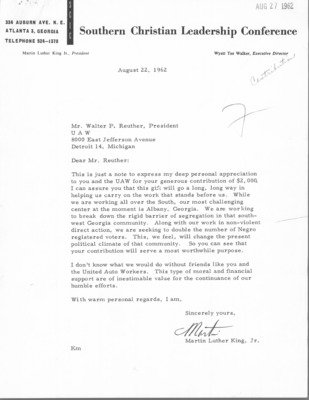
Mr. Jack Stewart
New York Times
229 West 43 Street
New York 36, New York
Dear
Jack:
Enclosed is a copy of the article to be printed
in the Saturday Evening Post and a copy of the final draft we
submitted.
As Linformed you, the final version is not yet
completed, since certain corrections are still required and
certain deletions needed to bring it within proper space
limits.
Best regards.
Sincerely,
IB:mp
oeiu 42
Att.
(2)
_
Irving Bluestone, Administrative
Assistant tothe President
AUG 13 1963
OFFICES
EDITORIAL
SATI'RDA’®
THF
‘*VENING
POST
&.
B
THOMAS
CONGDOON, JR.
EO'TOR
ASSOCIATE
a
Me
Fo
——_r
-
my
~f~—
FIFTH
NEW YORK
~@
*.
A
666
Mr.
Here
ticle,
CITY 19
—
awe
August
Dear
AVENUE
12,
1963
Bluestone:
at last
with
somewhat
is the
of
kind
the
condensed
direct
lead
--
version
stating
of Mr.
the
Reuther's
hard-core
ar-
theme
of
t
Qu
g
n
i
k
a
e
p
S
of
t
a
m
r
o
f
e
th
t
a
h
t
-e
n
i
l
t
s
r
i
f
the article in the very
s
e
k
i
l
r
e
h
t
u
e
R
.
Mr
if
d
n
a
,
e
c
e
i
p
e
th
on
s
r
o
t
i
d
e
e
th
d
l
o
s
e
v
'
I
.
s
e
r
i
u
q
re
Of
.
it
e
s
a
h
c
r
u
p
to
d
u
o
r
p
be
l
l
i
w
we
,
s
d
n
a
t
s
w
o
n
it
as
y
l
l
a
i
t
n
a
t
s
b
u
s
it
~
n
e
s
y
n
a
r
e
v
o
,
s
e
o
g
g
n
i
y
a
s
e
th
as
,
e
t
a
i
t
o
g
e
n
to
g
n
i
l
l
i
w
e
ar
we
,
e
s
r
u
o
c
or paragraph
tenee
Mr.
Reuther
considers
inappropriate.
d
o
o
g
be
l
l
'
u
o
y
t
a
h
t
g
n
i
d
n
a
t
s
r
e
d
n
u
e
h
t
h
t
i
w
e
l
c
i
t
r
a
e
h
t
g
n
i
t
p
e
c
We are ac
on
h
p
a
r
g
a
r
a
p
d
n
o
c
e
s
e
th
e
t
e
l
p
m
o
c
to
o
tw
or
e
c
n
e
t
n
e
s
a
us
e
v
i
g
to
h
g
u
o
en
d
n
a
w
o
n
y
a
p
to
e
k
i
l
d
'
e
W
.
t
n
e
m
y
a
p
y
a
l
e
d
t
no
d
e
e
n
t
a
h
t
t
Bu
.
12
e
g
pa
d
n
a
,
y
a
w
e
th
by
,
s
e
n
i
l
30
t
s
a
e
l
at
t
cu
to
d
e
e
n
l
l
i
t
s
We
.
r
e
t
a
l
y
f
i
l
p
m
a
.
p
l
e
h
e
m
o
s
us
e
v
i
g
hope you'll
I hear
May
from
soon?
you
Sincerely,
Mr. Irving
UAW
Solidarity
Bluestone
House
e
u
n
e
v
A
n
o
s
r
e
f
f
e
J
t
8000 Eas
n
a
g
i
h
c
i
M
,
4
1
t
i
o
Detr
TBC: al
ENC
|
e
THE
CURTIS
PUBLISHING
COMPANY
een
_
WE CAN
FORCE-PEACE
ON
By Walter
We
can
This
seem
make
P.
the
statement,
preposterous
within
the
only
RUSSIANS
Reuther
Russians
disarm,
at
glance,
first
because
ourselves,
Our reason
THE
have
tells
us
possible
many
way
of us,
already
that
may
given
up.
disarmament
to
deep
save
is
.
humanity
from annihilation
ye,t few of us really
the
that
test
a very
tinue
such
ban
test
ban
is wreng.
disarmament;
first
to pile
nuclear
defeatism
is not
modest
place.
step.
up nuclear
Both
Premier
weapons.
Khrushchev
a
a
untarily
fresh,
bold
#
-
fed
ae
’
a
1
»
only
con-
FZ!
%
at ees
na
disarmament,
strategy
it is
sides
.
since
But
to
we
force
neec
him
to
2
He
preves
signed
take
an
recently
ever
ON
The
could
dis-
ee
disarmament
eee
imagine
arMe
a
g
d
iage ube@iiasi
uch a strategy
There
-- a plan
fer
"waging
peace."
an entirely
new and powerful
the
-=- not
fold
contest
increase
nations.
must,
The
pits
enemy's
%
to
strategy,
greatest
injects
factor
inte
a doubling
in aid
maximum
It
the
as
strength
weakness.
but
any
sound
against
<<
a twehty-
world's
emergent
strategy
the
gee
great
America's
potential
and
is
its
There
is
tremendous
capacity.
industrial
in
assembly
our
now
ef the time--in our
winel, hag bere
example, per
capacity.
operating
And
skills
pacity
ef the
millions
Three
ate
per
cent
of
©
potential
ef unemployed
recessions
—.
fer .
appiyeprete (
and preductive
unused
workers.
industry,
is enormous
there
in the
can
only part
running
steel
shops
machine
factories,
lines
unused
strength
and
caAmeri-
SO
|
plateaus
rising
us
and
of labor
man:years
25 million
cost
have
unemployment
of
e
th
g
n
i
r
u
d
h
t
l
a
e
w
st
lo
$600 billion in
ten
past
Cry
years.
of
|
the
Soviet
The
Soviet
economy
stretched
same
and
space
the
of
the
at
able
taut , barely
the
al-
is
to meet
arms
and
needs
a
time
strug-
its
It
economy.
and
is
weak-
the
is
what
Union?
requirements
races
move
will
a genuine dis-
toward
strength,
Against this
the
that
awesome
agreement.
armament
ready
tnd Force
Khrushchev
Premier
gling
these
can be
potentials
ness
Harnessed,
already
20
propose
Premier
the
impose
Soviet
overstrained
we
that
do
Khrushchev
nations.
on
the
line,
a
challenging
with
developemnt
would
the
economy. x
compete
to
We
by
on
put
our
confident
in
us
of
the
faith
that
J saint on 10
tO
Cn
freedom
this
economic
peaceful
emerging
in
to
stress
a
strength
further
ex Oe
- ——-————
TEXT:
Flite TEXT
ae
ee
a
the
struggling
future
The
of
first
would
be
commit
the
to
an average
this
purpose
We might
not
effectivély
massive
be
needed
as
some
own
@ year
and
intended
This
to-
self-sustaining
I propose
that
we
a year
over
the
years.
abie
to
next
use
would
period
their
acquire
countries
But
we
aid an average
flat-
should
for
earmarking
to
can
less
the
of
the
prepared
properly
were
whole
much
vefore
beginning,
momentum.
25
that
end
it
a
steadily
the
where
aid,
the countries
world
toward
the
to
$20 billion
ourselves
over
move
perhaps
the
strategy
a massive
And
economic
economic
when
to
of
the
at
to
aid.
of
commit
ly
be
peace
into
countries
recipient
for
enough
Specifically,
commit
world.
economic
underdeveloped
growth.
assure
dramatically
of
a breakthrough
would
the
States
program
large
the
and
United
we
in
in our
publicly
program
ward
freedom
step
long-range
of
nations
| ee
these
of $20 billion
period,
best
to
spent
be
accomplish
the
objectives.
commitment
would
be
coupled
with
tr
a Tormal
challenge
to
conclude
to
shift
freed
by
peaceful
the
Soviet
a disarmament
the
men,
the
military
of
would
ment.
But
we
would
not
wait
agreement,
that
with
it
we
were
our
to
own
the
develop-
clear
Premier
and
mterials
economic
make
for
and
cutback
world
Union
agreement
machines
work
mediately
to
that
we
Khrushchev's
proceeding
massive
im-
aid
pro-
gfam.;This would be a declaration of
\
peace--an aggressive peace, «1 peace of-
Tensive.
The
hands
and
only
three
Premier
challenge,
in
the
meet
standards
or
accept
serious
disarmament
contest
ee
to
challenge
by
it
of
the
by
the
permit
diverting
to:
freedon
and obtain
reducing
Russian
to
agreement--for
would
our
countries;
challenge,
efforts
have
whether
emerging
our
with
contest between
the
living
agreement
5 Re
would
in
would
ponder
tyranny
through
Khrushchev
he
and
(3)
be
Confronted
the
resources
would
choices.
(1) default
(2) accept
“"
initiative
him
the
the
people;
but meet
it
negotiate
a
only
an
to
resources
such
stay
from
in
the
the
NRE pete
S08
arms
s 7
waging
system
knows
chev
he
not
lands,
in
munism
force
a diminishing
choice
contest,
economic
the
the
find
basis--with
the
approximately
aid
would
and
us
with
where
would
cn
Premier
long
present
the
States
in
Premier
So
resources?
$3 billion
no
have
compete
United
Khrush-
game.
the
in
proceeds
contest
military
to
then,
Khrushchev
as
stay
to
fails
become
world.
the
in
poverty
to
doomed
is
successors
his
Obliged,
an
it
areas,
Com-
Communism
If
power.
political
go
where
human
forging
bury
people
and
night
Khrush-
have-
the
the
of
most
where
but
to
it
on
chev
ied
do
counts
and
And
to
every
in those
ours.
going
have
social
Nida |
his
is
hungry
into
where
he
bed
to
arena
that, if
will
us,
to
superdor
is
us in
that
loudly
so
professes
he
very
the
in
peace
the
with
to compete
him
challenging
be
would
We
contest.
the
default
not
could
Khrushchev
Premier
that
obvious
is
It
~
ee
devoting
a year
to non-
Knrushcnev
com-~
ORRIN
RENIN free
nemertmcmmameremaam
TR 9
.
mitting
a billion--he
petition,
his
aid
areas
But
especially
heavily,
most
what
as
to
raise
nations
to
$5 billion?
be
serious
While
our
we
idle
not
I
economy
and
of
suffer
from
cause
the
“ upon
of
marked
unused
the
of
problems
are
starved
Soviet
pay
to
fense
against
of
do
meet
their
we have
the
sur-
Russians
both.
And
their
compounded
in
be-
farms
order
of
to
stay
race.
Khrushchev
belts
to
their
fertilizer
strain.
Russians
While
fiber,
slack,
resources
the
shortages
and
by
by
anything
and
have
arms
Premier
to
additional
is marked
great
food
they
machinery
in
is
and their plans.
pluses
interests.
commitment
an
machines,
agricultural
rae
provide
have’ enough
needs
Soviet
a few
trouble.
have
men
in
and call upon other
economy
Soviet
While
com-
concentrates
does,
our
in
Then Premier Khrushchev will
in
the
stay
he
he
crucial
if we
if
$20 billion a year,
free
can
can
people
for
the
to
nuclear
"threat
successfully
tighten
weapons
of
the
their
in
de-
Wall
call
Street
warmongers."
believe,
however,
& gambler
calling
to
ther
drastic
omic
aid
there
tet
the
to
he
of
over
living
enough
people
to
for
in
austerity
Sov-
measures,
that
he
d
Khrushchev, promised.
econ-
the
hopes
standards
fur-
Already
disturbances
dampened
of
for
pay
countries.
new
that
is
consequences
sacrifices
been
strictures
is difficult
Russian
other
have
higher
the
to
Union
that
risk
upon
It
for
the
Premier
peg
fh
This
leaves
Khrushchev
our
this
find
the
resources
a cut-back
unilaterally.
Neither
of
the
side
other
would
have
agreement
arms
on
But
He,
Premier
the
he
reduce
of
of
to meet
Soviet
cannot
like us,
stalemate
Thus
for
is
do
a.
terror.
armaments unless
Premier
Khrushchev
pe-eirternative—pad) to
fool-proof
arms
seek
reduction
disarmament.
again,
Khrushchev
can
does.
ultimate
Here
seek
way
establishment.
prisoner
and
one
challenge:
military
the
to
only
at
seems
first
to
reduction
glance,
Premier
have
choices.
on
basis
a
He
which
could
wae
—
ee SE
*
ae
would
maintain
a
between
Ours,
his
but
on
him
by
as
we
we
could
the
total
turn
by
adding
our
in the peace
for
Premier
seek
total
United
Nations
Soviet
against
the
as
the
the
re-
to
econ-
seek
to
agreestay
The only real answer
therefore,
coupled
creation
peace
Union
of
reductions
disarmament
the
on
upon
them
Khrushchev,
means--possibly
for
For,
Overstrained
arms
race.
posed
pressure
their
further
solu-
thus
and
on
real
program,
Soviets
compel
Arms
aid
competitive
would
sides.
expenditures,
part
the
ment
ese
to
no
tighter
up
This
and
both
offensive.
screw
resources
the
peace
the
leased
for
problems
military
economy
omy.
Overkill
be
our
Soviet
the
would
economic
reduced
stepping
for
total disarmament.
however,
our
relationship
a lower-level
seek
reduction,
for
present
potential
Or he could
tion
the
well
possitdlity
of
as
with
of
force--to
is
to
some
a4 strong
safeguard
ourselves
Communist
Chin-
agrression.
This
proposal
Strategy
will
for
a positive
inevitably
meet
peace
with
op jece
—
“ee
ead
ee
ome
10
tions.
I hope
immodest
posals
which
were
later
proved
& year
out
of
production.
vehemently
cause,
in the
past,
by many,
For
example,
Harbor,
with
Allies,
I proposed
idle
the
war
manufacturing
the
auto
Top
industry
executives
argued
this
impossible
be-
industry
was
tneir
to
be
j,
= ef)
oe5fiwy
f
Harbor, ‘the
"
that
they
of
had
their
were
machinery
converted.
Pow
military
plants
single-purpose
not
four-fifths
a number of) pro-
impractical
insisted,
Pearl
boasted
the
with
could
after
the
that
they
equipped
Pearl
of
considered
in practice.
for
conversion
be
advanced
considered
badly
capacity
not
that
I have
before
going
will
if I note
which
that
it
Some
?
auto
time
executives
converted
about
machinery
to
arms
production.
In
1950,
peace
I proposed
offensive
of the
the
Peace
our
most
novation
Corps.
Peace
brushed
off
whicn
as
Corps
for
included
This
idea,
impractical.
is
successful
since
a plan
the
foreign
Marsnall
the
too,
Yet,
recognized
a total
as
was
7
today,
by
policy
Plan.
concept
far
in-
sah
”
d
r
o
f
f
a
t
'
n
a
c
e
w
"
t
a
h
t
d
e
u
g
r
a
e
b
l
l
i
It w
Such
propose.
productive
ormous
economy.
dean
of
needed
a greatly
for
demand,
in
The
city.
under
losing
are
now-idle
The
this
fabricate
goods
rise
and
reaction,
to
a
second
services
create
newly-employed
wuve
wnat
stili
workers
to
earnings
would
This
needs.
family
dev-
economic
their
spend
their
satisfy
give
the
would
elopment
o*
tools
of
would,
more
would
work
to
put
be
would
proposal,
who,
women
and
men
result
a
as
year
this
of
one-third
is hardly
$20 billion
we
what
in money.
not
and
goods,
to
tractors,
trucks,
other
and
tools
given
be
would
aid
eccnomic
increase
would
It
thrust.
with
economy
American
the
provide
would
peace
the
of
waging
the
in
billion
$20
investment
the
Actually,
Amer-
the
of
potential
en-
the
comprehend
not
do
who
those
from
expected
be
can
a reaction
demand
in
Sobsa
rave
a
for
cnain
The
incomes
ve
My
is
answer
the
balanced
to
get
the
of capital
the
65
=
bp
rodtibe ar
oui el
Americm
which
tess }t0
would
people
with
faced
help
may
underway,
investment
if suidenly
far
It
economy.
program
win
a shooting
the
retrievable,
will
provide
peace.
expenditures
national
not
hestitate
income
far
war.
a minute
to
makes
much
It
Moreover,
for
peace
beyond
initial
the
RE tT
LL LSE OIL RT
for
"
spend
PRIN
IR
SME.
purposes
what
mmeniim
is needed
spend
to
in
awa
arent
a program
such
original
cost.
SUN
financing
sense
more
Hs MN aaa aR. ren
first
Paradoxically,
expenditures
under
an
have
we
bprrow
returns.
ail
initia
<M RRR
after
to borrow
future
net
will
om “ange emg
corporations
as
just
arse
only
budget
necdéssary
be
\
while
the
can balance
we
that
OR
as
this
oe
12
profits
which
and
them
would
revenues
and
funds
the
proposal
tax
more
industrial
for
more
more
have
yield
also
would
fac-
the
taxes;
employed
that
tories
pay
to
which
of
out
expansion.
of
Critics
during
program
that
..
Earlier
this
year
a committee
Lucius
Clay
submitted
General
President
report
a report
vastly
as
its
cedes
eign
an argument
program
expanded
Unhappily,
on
the
too
limited
for
much
72
assistance
Clay
percent
against
here
Report
of
our
appropriations
the
proposed.
stands
argument
The
head.
that
The
aid.
This contention will doubtless
too many."
raised
the
present
our
‘attempting
is
under
to
on foreign
that
contenhed
aid program
be
. (TO KUM)
simply
is
answer
My
place?
takes
spurt
the
before
years
few
first
those
for
money
the
itself
tovtai
this
truth
con-
foryear
a
the
the
get
we
where,
debt.
national
will
ask,
will
they
the
in
hike
dollar
a multi-billion-
mean
would
program
aid
|
billion
a $20
outset,
the
at
at least
that,
say
will
rman
consists
ing
@id
assistance.
This
and
military-support~
leaves
no more
than
program.
The
inadequacies
starkly
our
of military
most
of
that
highlighted
by
successful
aid
program
comparison
are
with
undertaking,
Marshall Plan. While that Plan was in
person living in the 16 European
tries
reached
by
it.
Last
the
coun-
year,
our
total
foreign
assistance,
including
that
Support
of military
programs,
came to
in
only $1.85 per person
in all underdeveloped
countries
Communist
a@ per
aid
of
outside the
capita
programs
the
Shall
amount
Plan.
basis,
have
we
our
present
shrivelled
provided
(And this
is
to
under
to
bloc.
On
economic
a
the
sixth
Mar.
say nothing
|
|:
|
A
Of
price
plan.)
changes
The needs
countries,
pressing
served
than
by
offensive
But
ment
the
these
which
if
aid
masses
forms
once
begin
CO,
to
be
countries
occasional
the
them,
UP
impoverish-
will
tada
to
be
yield
e
i
PE
oy
fammere-rapittty
These
achieved
development
political
3
among
:
the
and
nations.
results
to
une
effective
recipient
dramatic
where
waste.
oe
effective
show
peace
administra-
a
will
truly
some
like
is
the
more
countries
fairly distributed
of
meant
that
of a total
and
underlies
its benefits
xe
entail
problens,
epee seaman
Plan.
waging
inefficiencies
of
enormously
the
Marshall
will
countries
the
of
days
ns tine
underdeveloped
are
those
the
the
of the
moreover,
Obviously,
tive
since
a NUNN
programs
in
a
few
setting
is
favorable.
the’
r
f
L
o
hope that gxten
!
heir
s
a
J
do
7
ations, even when
/
not\exactly
7
-
/
mirror
>
|
|
omy
,
/ lown,
will ‘resist
f
cpa
ff
/
|
a)
}
encronchanny,
/
/
/
j
eo
_™
from
aid
to
our
Yet
with
economic
emerging
of
of recent
nations,
do not
exactly
Communist
We
are
"New
facilities
nations. "osahe
encourages
even
when
mirror
the
their
and
fsovern-
more
need
of basic
years
J. Watson,
2s Thomas
nations
developed
adherent
an
reccgnizes:
IBM,
dictate
will
which
stanch
so
enterprise
ownershio
more
such
As
patterns.
faced
may be
netions
necessities
underdeveloped
do
patt-
conform
ern.
ment
economic
matter
not
president
essential,
nc
do
of private
how
projects,
that
other
for withholding
calls
Clay Report
The
thein
evidence
hepe
that
economies
will
cur
ovn,
in
hictory
resist
encroachment.
at
a place
where
;
,
ac
EN
ai ara
ll
i
i
es lel
Oe
eT
eee
15
the
pragmatic
idealist
practical
realist.
seemingly
take
are,
in
the
fact,
deal
the
a "hard
social
No
Khrushchev.
Premier
by
tompeting
able
of
rising
believes
economic
us
the
take
act
his
can
as
incap-
attain
full
employ-
and
full
use
time
short
United
interest.
in
occasional
the
groups
we
effort
do
not
and
cannot
of
boldly.
victories
of
view,
sense
our
pro-
make
peace.
so.
need
our
of
are
we
think
I don’t
we
with
society
selfish
above
trade
hours
to
free
our
pressure
expansively
the
visit
that
that
Com-
Premier
four
and
right?
confident
several
when
comparable
Is he
with
only
war
and
which
resources
for
ducing
of
unwilling
than
production
full
ment,
we
of
spent
I
during
torn
are
better
Together
depicted
He
States.
hands
problems
out
this
colleagues,
union
the
power.
its
knows
who
on Communism
they
pressing
the
thai
line”
into
injustice
builds
one
the
the
become
ebusad
playing
with
munism
a
Too
Communists ybecause
to
He
has
war
I am
to
make
vespite
those
of
who
urgency
|
seems
to be
building.
increasingly
crisis
to
in
where
are
we
to
hold
both
Abraham
simple
not
day,
long
bread
peace
in
do
the
of
point
initiative
move
abyss.
which
be-
manWe
are
foundations
men
can
freedom.
in his
free
half
profound
that
and
freedom
a world
to
Con-
sense
the
the
in
warned
and
seize
lay
and
Lincoln,
half
our
nuclear
to
and
really
enough
community
wisdom,
exist
secure
the
from
Cubas
reached
to
seems
drift
new
has
I believe,
a world
have
to
I think
ready
it
nation
events
fact,
back from
ready,
of
day
unmanageable.
kind
tw
one
urgency,
and
unwilling
crisis--into
gos--until
come
The
America
half
cannot
but
could
slave.
be
To-
made
fed
and
be
Dart:
half
starv-
ing.
“a
a
Velin
ee ee
Wwe
see
Week
wr
ee
fas,
Co
Laren
Che
| es
ZA
ee
-
“f
lh al erect
ee
Wnt
Ate
? point on 10
nner Ege TEXT:
eee De
Elite TEXT
A Ee te. 5 ->li
16
building.
crisis--into
nuclear
community
bread
and
Lincoln,
not
free
day,
peace
secure
and
the
in
which
in his
warned
half
lay
ing.
are
foundations
men
can
profound
that America
and
half
freedom
in a world
We
freedom.
simple wisdom,
exist
abyss.
man-
half
cannot
fed
could
slave.
be
To-
made
half
starv-
Kv eo,
- eres.
Oy
Boi
and
but
ee
:
Abraham
to
move
An
both
to
initiative
oo
have
enough
the
I believe,
a world
the
point
-
ready,
from
long
the
of
‘
|
|
>
back
it
seize
sense
oe
kind
hold
to
be-
IE
to
ready
reached
do
hn
are
we
has
our
Con-
“
where
really
I think
fact,
and
~
in
of
events
unmanageable.
urgency,
and
day
Cubas
nee
come
one
new
from
ee
gos--until
drift
et
to
to
seems
8 ae
crisis
unwilling
nation
Re 8 eee
>
increasingly
The
<a
to be
™
seems
ected.
i
C:
on
Ir
e
th
f
o
s
de
si
th
bo
On
than $960 million in
the
pot."
The
stake
ed theraselves into their
a
et
vi
So
e
th
of
s
s
e
n
k
a
e
w
e
th
is
Against this, what
on
ec
ng
li
gg
ru
st
,
ed
in
stra
Union?
It ie its
a
o
t
s
e
t
a
t
S
d
e
t
i
n
U
e
h
t
t
i
m
m
o
c
to
massive |
arena where he professes so loudly th
:
c
e
f
d
o
l
e
i
f
e
h
t
it is in
ng
hu
d
e
b
o
t
o
g
e
l
p
o
e
p
e
h
t
f
o
t
s
o
m
lands, where
future outside
the countries where it is alrea:
l
p
o
e
p
d
e
t
t
i
m
m
o
c
n
u
e
h
t
f
o
s
d
n
i
m
d
n
a
s
t
r
a
e
h
e
h
t
r
o
f
the contest
e
ng
le
al
ch
e
th
et
:
me
eri
mat
to
and
n
ie
me
in
ces
our
res
the
ean find
stalemate of terror.
of
ou:
:
t
n
e
m
a
m
r
a
e
c
u
d
e
r
n
a
c
Neither
e
c
a
e
p
e
l
a
t
g
o
t
n
r
u
o
e
f
l
o
the chal
offe
ment program under ¢
world against any possible duplicity
maintain the present relation-
(i)
A werkable nuclear tect ban, with international control
z
th
eam
fl
d
an
ns
gu
th
wi
m
er
th
nd
se
to
be
ll
there wi
“17«
6
5
9
$
te
t
n
u
o
m
a
d
l
u
o
w
s
r
a
e
y
0
1
t
x
e
n
e
h
t
ever
billion
«
——
workers moved from
ee ae
idlen s
Fl lt
——
ee
into the
ee
ee
ee
a
newly create:
eeeT
a
ee a
ee eee
a
eee as
ee
eee
ed
ne
y
ar
it
il
nm
no
e
h
t
et
me
to
d
ai
in economic
ae
Tae So Se
are ee
eee
eae
eee
eee
ee
ee
ee
ee ee
ee
ee
See
ee
ee a
ee
Seer ee
« 21
y
c
n
e
g
a
l
a
i
c
e
p
s
e
h
t
r
o
,
e
c
a
e
P
r
o
f
e
c
n
a
i
l
Grand Al
September 25,
Mr,
Thomas B,
Senior Editor
Congdon,
1963
Jr,
The Saturday Evening Post
666 Fifth Avenue
New York 19, New York
Dear
Tom:
,
me
e
ev
li
be
d,
an
;
do
d
ul
co
I
Enclosed is the best
,
re
fo
be
s
rd
wo
th
wi
le
gg
ru
st
a
ch
su
have never put up
I
|
s,
ne
li
35
e
th
t
ou
t
cu
to
le
ab
en
be
I believe that I have
,
se
ur
co
of
,
nt
me
dg
ju
ur
yo
t
us
tr
I
e,
os
cl
ry
ve
be
y
ma
it
gh
ou
th
al
,
ts
en
em
ir
qu
re
ur
yo
et
me
to
r
de
or
further cuts are needed in
if
Sincerely yours,
ve
ti
ra
st
ni
mi
Ad
e,
on
st
ue
Bl
ng
vi
Ir
Assistant to the President
IB:d
oeiu4Z
Enc,
Air Mail
Special Delivery
EDITORIAL
THE
SATURDAY
EVENING
Crd.
POST
PouRe
THOMAS B. CONGDON, JR.
SENIOR
OFFICES
666 FIFTH AVENUE
CITY I9
September
Dear
Mr.
e
f
i
U fm #
NEW YORK
Fy obs
EDITOR
Fs ot
17,
1963
Let's kill two birds with one (blue)stone.
These galleys need a last
I could cut the
scanning by you, and they need to be cut 35 lines.
have
te
see
the
cuts
anyway.
Se why
In paragraphs ending with a line composed of one or two words, you can
easily gain a line by cutting a word or phrase higher in the paragraph.
De all these first, and then see how much of a bleck cut you need to
make.
If you
short,
If you fall
cut the full 35, we'll put yeu on the Pest masthead.
I'll try te get the rest -- but then you'll have no complaints]
This may be scheduled at any minute, and so I hope you can
promptly and shoot it back to me.
Many thanks.
_
Mr. Irving
TBC:al
ENC ©
Best,
Bluestone
THE
CURTIS
PUBLISHING
COMPANY
tackle
Ps
79
£9
«
Bluestone:
lines, but if I did, then you'd
doen't you take a whack at it?
2/%.~
this
9
-p—
POST GEN
(3375) 9-9-63 McAllister 13 3-12 pi
16833A op 10 9 an 10 pt 327
om.
We Can Push the Russians Into Peace
"as
By Walter P. Reuther
"
es
We
-9
S
Ny
:
place.
.
eye
from annihilation, yet few of us really
imagine disarmament could ever take
egies
can make the Russians disarm.
This statement, at first glance, may
seem preposterous, because many of us,
deep within ourselves, have already given
up. Our reason tells us that disarmament
is the only peeetete way to save humanity
enemRs eT
The rememtigseigned nuclear test ban
proves that such defeatism is wrong, But
the test ban is not disarmament; it is only
a very modest first step. Besh-sides.eenLr
‘
Premier Khrushchev wilknever voluntar-
<BR
ily agree to effective disarmament, we
need a fresh, bold strategy to force him to
disarm.
There is such a Strategy—a plan for
“waging peace.” It injects an entirely rew
and powerful
a doubling
rope
WoT
factor into the contest—qam
A
buia-suemippordincrin
easaied
MAS SIME
_
mm
2
greatest weakness.
2
strength against ihe een) —
~
maximum
5
nations. The
Strategy, as any sound strategy must, pits .
hy
to the work's eme rgent
America’s great strength is its unused
industrial capacity. There is tremendous
potential in our factories, machine shops
and assembly lines now running only part
of the {IM e —He@eit. 666eLinduetry-former:
Aebiahty dieltan He -hee-aeee OpereirE AE atest:
SGupeveent--ef—eapeeity. And there is
enormous potential in the unused skills
and productive capacity of the millions of
unemployed American workers. Th ree re
-
i
.
%
h
e:
:
cessions and rising plateaus of unemployment have cost us 25 million man-years
of
labor and $600 billion in lost wealth
during the past 10 years. Harnessed, thes
e
awesome potentials can be the positive
force that will move Premier Khrushchey
towardagenuinedisarmamentagreement..
2
Against this strength, what is the weakness of the Soviet Union? It is its struggling CCONONY AER arose peepee rR al
-
ready stretched taut, barely able to mee
t
the requirements of the space and arms
wemes of the Soviet people. Our strategy,
then, should be to draw the Soviet Uni
on
into a contest in which we can take maxi
-
mum advantage of our unused econcmic
strength to impose further stress on the
already overstrained Soviet economy.
We can do this by challenging Pre
mier
4
Khrushchev to compete with
us in the
peaceful economic development
of the
emerging nations. We would put
our faith
in freedom on the line, confident
that by
promoting the economic advance
ment of
these struggling nations we wou
ld assure
the future of freedom in the wor
kd.
The
first
step
in
our
peace
strategy
would be publicly and dramatic
ally to
commit the United States to
a massive
long-range program of econom
ic aid, @
Baageam large enough to move the
coun-
;
tries of the underdeveloped WOrld-eeew
elaby
toward a breakthrough into selfsustain-
, ing growth. Specifically, I propose t
hat we
co
mmit an average of $20 billion a ye
ar to
this purpose over the next 25
years. We
ay not be able to use that much
effec-§
tively at the beginning before the
recipient
countries are properly prepared
for masSive aid. And prosinanens fess {be n
eeded to.
ward the end of the period as som
e of the
countries acquire their own economic mo-
me
Ris
r«
i
Mh
“”?
y
‘Owardagenuinedisarmamentagree
ment.Against this strength, what is the
weakness of the Soviet Union? It is its
strug-
gling CCONOMy AREBOrgecenoryes
a |-
ready stretched taut, barely able
to meet
the requirements of the space an
d arms
races and at the same time the ne
eds setae
wemes of the Soviet people. Our s
trategy,
then, should be to draw the Sovie
t Union
into a contest in which we can tak
e maximum advantage of our unused ec
oncmic
strength to impose further stress
on the
already overstrained Soviet economy.
4
We can do this by challengin
g Premier
Khrushchev to compete w
ith us in the
peaceful economic develo
pment of the
emerging nations. We would
put our faith
in freedom on the line, confi
dent that by
, ing growth. Specifically, I
propose that we
commit an average of $20 bil
lion a year to
this purpose over the next
25 years. We
‘py
not be able to use that much
effec-f
tively at the beginning before
the recipient
countries are properly prep
ared for massi
ve aid. And pamieps less (nBeeedetd
o
.
w
ard the end of the period as
some of the
countries acquire their own e
conomic momentum. But we should flatl
y commit ourSelves to earmarking for eco
nomic aid an
average of $20 billion a ye
ar Over the
serious efforts to negotiate a
disarm arent
agreemen
;
:
.
é
te~
er
*
*
‘
*
*
;
23
a
é
ae
—
;
°
.
ae
power.
Obliged, then, to compete
with us in an
economic contest, where
would Premier
K
hrushchev find the resourc
es? As long
as the contest proceeds o
n the present
6 units
6117
774 y
out
Ps
|
POST—Unsched.—Gen.—B
& W
| (17704) 9-9-63 Powell 13 3-12 Picas
16833B op.
10 9 on
10 Pt. 327E
2—We Can Pus the Russians Into Peace
While our economy is marked by slack,
the Soviet economy is marked by strain.
While we have great unused resources of
idle men and machines, the Russians do
not have enough of anything to meet
their needs
and
their plans.
While
have surpluses of food and fiber, the
sians suffer from shortages of both.
their agricultural problems are
pounded because they have Starved
we
RusAnd
comtheir
farms of machinery and fertilizer in order
to stay in the arms race.
their belts to pay for defense.
It is diffi-
cult to believe, however, that he is enough
cf a gambler to risk the consequences of.
calling upon the Russian people for
further drastic sacrifices to pay for eco-
nomic aid to other countries. Already
there have been disurbances in the Soviet
Union over new austerity measures, s¢pig~
ie
CAM
hrushchevéte)find the resources to meet
our challengeg—a—cutback—ony
CRIP
ot
the
SG |
Soviet"
military establishment. But he cannot do
this unilaterally. He, like us, is a prisoner
of the stalemate of terror. Neither side
can reduce armaments unless the other
does. Thus Premier Khrushchev would
have no alternative but to seek agreement
6 ~——@fFoolproof arms reduction and ultimate
disarmament.
Here again, wh
dente
abet
:
Premier
Khrushchev seems to have choices. He
could seek arms reduction on a basis that
would maintain the present relationship
between his potential for overkill and
ours, but on a lower level for both sides.
Or he could seek total disarmament.
Arms reduction, @iamggeer would be no
real solution for the economic problems
posed-for him by our total peace offensive. For, as we reduced our military ex-
penditures,
we
could
turn
the screw
tighter on the Soviet economy by adding
part of the released resources to our aid
program, thus stepping up the competitive pressure upon the Soviets and their
Overstrained economy. This would compel them to seek agreement on further
arms reductions to stay in the peace race.
The only real answer for Premier Khrushchev, therefore, is to seek total disarmament coupled with some means—
possibly the creaiion of a strong United
Nations peace force—to Safeguard the
Soviet Union as well as ourselves against
the possibility of Communist Chinese
aggression.
“This proposal for a positive peace
strategy will inevitably meet with objec-
tions. | hope it will not be considered im-
modest if I note that a number of pro-
posals which | have advanced in the past,
which were considered impractical by
many,
later proved
cut in practice. qiee
exemple; a year before Pearl Harbor,
with the war going badly for the Allies,
] proposed conversion of the idle manufacturing capacity of the auto industry
to military production. @eg industry
executives argued vehemently that this
was impossible because, they insisted,
their plants were equipped with single-
purpose
Pearl
machinery.
Harbor,
tives boasted
Some
however,
time
after
the auto execu-
that they had converted
about four fifths of their machinery to
arms production.
In 1950 I proposed a plan for a total
peace offensive that included the concept of the Peace Corps. This idea, too,
was brushed off as impractical. Yet today
the Peace Corps is recognized as by far
our most
successful
foreign-policy
Ge
had=pverieed: Last year, for example,
longshoremen in the port of Cdessa
called a strike to protest a shipment to
Cuba of consumer goods badly needed
at home.
‘
“
CUTTING
CAC Kk
mg
eEnhy UY AUGing
part of the released resources to o
ur aid
‘
program, thus stepping up the c
ompetitive pressure upon the Soviets a
nd their
Overstrained economy. This would
compel them to seek agreement on
further
arms reductions to stay in the peace
race.
The only real answer for Premie
r Khrushchev, therefore, is to seek to
tal disarmament
coupled
with
some
Ees
'
means—
possibly the creation of a strong U
nited
Nations peace force—to Safegua
rd the
Soviet Union as well as ourselves
against
the possibility of Communist C
hinese
aggression.
‘This
proposal
for
a positive
peace
strategy will inevitably meet with objec-
_ tions. | hope it will not be considered immodest
if I note that a number
of pro-
posals which I have advanced in the past,
which
were
many,
later proved
exemple,
wit,
considered
a year
cut
before
impractical
by
in practice. qer
Pearl
Harbor,
the war going badly for the Allies,
] proposed conversion of the idle manu-
facturing capacity of the auto industry
to military production. @®ep industry
executives argued vehemently that this
was impossible because, they insisted,
their plants were equipped with single-
purpose machinery. Some time after
Pearl Harbor, however, the auto execu-
tives boasted that they had converted
about four fifths of their machinery to
arms production.
In 1950 I proposed a plan for a total
peace
offensive
that
included
the con-
cept of the Peace Corps. This idea, too,
was brushed off as impractical. Yet today
the Peace Corps is recognized as by far
our most successful foreign-policy innovaiion since the Marshall Plan.
It will be argued that ‘“‘we can’t afford”’
the massive economic aid required to
| TAis-—~implement@he)peace strategy S
ummeneapenter
piapess. Actually the investment of $20
billion in the waging of the peace would
provide the American economy with a
greatly needed thrust. It would increase
demand, for economic aid would be given
in trucks, tractors, tools and other goods
and not in money,
7
7
on is hardly one third of —
lli
'bi
$20
The
what
-
we are losing this year as a result of
unen-ployment and idle productive cap
ac-
ity. The now-idle men and women who,
under this proposal, would be putto work
to fabricate the tools of economic devel-
opment would spend their earnings to
satisfy their family needs. This would
give rise to a second wave of demand
that would, in a chain reaction, create
stil more jobs. The newly, employed
workers. would have inceines out of
which to pay taxes; and the factories that
employed them would have more profits
which would also yield more tax revenues
and more funds for industrial expansion.
nner
4
SRO
we
oe
De
nF
5
°
Mo
caine
i
5
%
*
€
*
a
Pe
eon
reeie
aCN s.
say°
tee:
.
*Hit, %
i
&
Earlier this year a comm
ittee under
Gen. Lucius Clay submitt
ed to the President a report on foreign ai
d. The report
contended that our pres
ent limited ‘aid
program is “trying to do
too much for
too many.” This contentio
n wil] doubtless be raised as an arguire
nt against the
vastly expanded program
here proposed.
Unhappily, the argument St
ands the truth
on its head. The Clay rep
ort itself concedes that 72 percent of our t
otal foreignassistance appropriations e
ee Con.
Sis
.
billion ‘dollars inxéGGnomic
ald to meet
the nonmilitary needs
of an underdeveloped world gasping for
h
e
l
p
.
A
s
against th
oar, “a
TR
ts of military and militarysupporting
assistance. This leavesno
more than a
‘
0
NIE
> vKEEL ¥
r
e imperatives of the situati
on,
“trying to do too little for t
oo few” becom
es, a more objective
our Current aid program.
description of
ers.
OUR
The inadequacies of Ghat) pro
gram are
Marshall Pian.
Speraiien,
an averageof
person living in
tries reached
Wihilestetopleiewes in
Qurfcontribution anccunted
to
$11.85 annually for each
the 16 Eurcpean coun-
ASD
—~ MAK
SAALL
PLAN
by it. Last year our total
Forerenassistance, including th
at in support
of military programs. ‘c me.
to only
$1.85 per person.in all funds
€
COUNtrieS -watsrde-thenL<
ae
On a per capita basis Our
present eco-
REC IP LENT
nomic-aid pregrams have shrivel
ed oa”
sixth of the amount we provided
under.
the Marshall Plan.
Obviously the waging of a total.
peace
Offensive will entail some ad
mini
inefficiencies and occasional
strative
waste. But
—
7
.
|
}
:
cod
these problems, like the impover
ishment
which underlies them, will vield
to dotermined effort. it may be that
political
ment prcgrams begin to show
drematic
Tesults item fem epeutries
where the
Political setting is favorable. At t
his point
the populations of lagging mations.
sae
aasure~~ thas
Fog
such progress
_ The Clay report cal
ls for withholding
aid from Projects,
no matter how essen
tial, that do not conf
orm to our economic
eg
fe
et _eeer
ASS
-
mrt
F
Sergey
= ana
|
‘
west
|
oe
reforms will be necessary in
some coun_tries if aid is to be effective.
These reforms
will be rapidly achieved o
nce develop-
speraiem, OU
an average’of
ECoNomic
NM
VERS | KD
MOLEC ET SLUT
AE GV OE
OO
~~
to
Ontribution amounted
$11.85 annually for each
MAR
PLA
SA ALL
person living in the 16 Eurepean countries reached by it. Last year our total
——~Ceporrtegnof)
fereignassistance, including that in sup$1.85
military programs,
per person.in
‘came
all
COUNtries -wantsrdethe-Gon
On
a per capita
to only
Gade
basis our
:
RECIPIENT
"
present
eco-
nomic-aid pregrams have shriveled to a
sixth of the amount we provided under.
the Marshall Flan.
Obviously the waging of a total peace
offensive will entail some administrative
inefficiencies and occasional waste. But
these problems, like the impoverist ment
which underlies them, will yield to doter- ”
mined
effort. it may
be that political
reforms will be necessary in some coun-
_tries if aid is to be effective. These reforms
will be rapidly achieved once development prcgrams kegin to show drematic
results iene s
Seewoumtries
where
the
polirical setting is favorable. At this point
the populations of lagging aavons alia
mest
ound fied aay. te aasure— that
their governments create the condi
tions
will enatde
such
progress
them.
toe, wo share
in
a?
fat
an
adherent
Thomas
1.B.M.,
need
J.
of
private
Watson
Jr.,
recognizes,
more
enterprise
“New
government
as
chairman
and
of
Nh a
Ownership
9 cola NT .
|
under
of
We are at a place in history where the
pragmatic idealist has become th
e pracSea atooien ge ome 464:
we ae
The Clay report calls for withhold
ing
aid from projects, no matter how
essential, that do not conform to our ec
onomic
pattern. Yet emerging nations
may be
faced with economic necessities
which
will dictate other patterns. As so
staunch
ee ~ wba
ln
CE
ie ASR
=,
eatin
OPED
ts
nif’
tical realist. See~eteen those who s
eem-
orren
t-~pleyinpinto the hands of the
FLAP
Communists,
because they are unwilling
to deal with the pressing problems
and
the social injustice out of which Co
mmunism builds its power.
No one knows this better than Premi
er
Khrushchev. Together with several tr
ade-
union coHeagues, I sperit four hour
s with
the premier during his visit to the Unite
d
States. He depicted our free soci
ety as
torn by competing pressure groups
in-
capable of rising above selfish interest.
He believes we can attain full employ-
AND:
mentafull production éedabeghbeanm
sccnemnie—eeee@urees Only when we
are
producing for war and that we can
not
make a comparable effort in ti
me of
peace.
is he right? I don’t think so. I am
confident that we do not need war to
make
us act expansively and boldly. ec
pies
f
soumetexbeobwitmg: The nation seems
C
» Vee
increasingly unwilling to drift from
crisis
to crisis—into(New Cubas and Congos—
wa
Min
ware
until one day events really do bec
ome
unmanageable. 1 think our sense o
f
urgency, ¢+m~deet: has reached the ‘
pomt
where we are ready to seize the init
iative
and Pe Dbish-atheaggeiemensmlembes. (1) Ov:
maenkind back from the nuclear abyss. Th
e
United States is ready, | believe,
to.
ee
fr
e
th
g
n
i
p
a
h
s
e
r
in
ip
pw rovide leadersh
orld’s. defense community into a Gran
d
Alliance for Peace with a new and height
ened sense of historic purpose. Abraha
m
Lincoln, in his profound toyiieeimepie
wisdom, warned that America could no
t
exist half free and half slave. T
oday
peace and freedom cannot be made se
cure in a world half fed and half starving
.
As a nation we have always réspon
ded
to the challenge of war by making a
We must do no less if we are to win the
peace.
7 units
-
|
END
6062
TCTAL
EF FeeT,
if
- Item sets